


Category: History
-
Prefabs
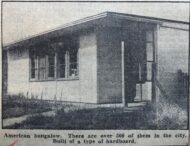
Over 156,000 temporary bungalows or “prefabs” (abbreviated from prefabricated buildings) were manufactured and erected across the UK between 1945 and 1948 to help with meeting the shortage of housing after the war. Their fabrication and distribution was managed centrally by the Ministry of Works, which also owned the buildings, although sites and infrastructure were the…
-
The 10¼ inch gauge miniature railway
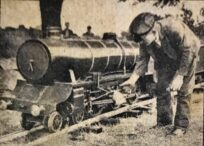
In August 1946, a year after the end of the Second World War, a model enthusiast, George Archibald Dingle who lived at Kelly Bray near Callington, set up a miniature railway in the park and gave rides to the public. The locomotive, coaches and track were owned by him. He had approached Plymouth City Council…
-
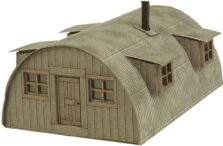
The Nissen hut cafe
In the photo below of a 1949 cycle race, the curved roof of a Nissen hut can be seen behind the crowds and to the left of the former clock tower. It was brought to Central Park in 1946 for the sale of refreshments. The hut was dull green in colour and measured 24 feet…
-
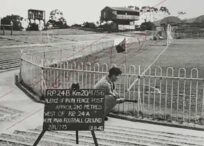
1946 Ordnance Survey
After the Second World War, there was a pressing need for new maps. Ordnance Survey (OS) surveyors used triangulation points in the country and revision points (RPs) in towns as reference datums. These known spots were often on the corners of buildings and other immovable features, which could be fixed to centimetre accuracy. Being able…
-
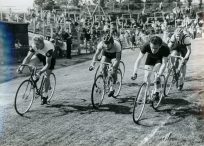
1944 – 1959 Cycle races
Even before the Second World War had ended, the Western Morning News reported in August 1944 that the first massed-start scratch cycle race to be held in the South West had taken place in Central Park. A scratch race is a track cycling event in which all riders start together and the objective is simply to be first…
-
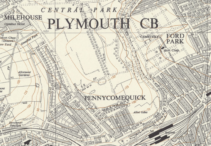
Prisoner of War Camp
A 2003 English Heritage study records a Prisoner of War camp at Home Park, number 673, although the grid reference is almost certainly incorrect and the study does acknowledge the difficulty in identifying locations. The study report is here: https://historicengland.org.uk/images-books/publications/prisoner-of-war-camps/prisoner-of-war-camps/ A map survey from 1949 shows where huts were located near the north end of…
-
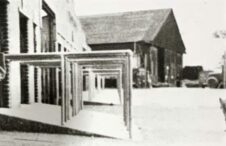
US Navy food store
In 1943, the US Navy established a forward operating base in Plymouth to support the ships that would take troops across the English Channel to fight in France. It was known as the United States Naval Advanced Amphibious Base (USNAAB) and its engineering, supply and operations units were spread across several locations. The food store…
-
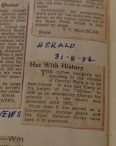
Emergency feeding station
By 1942, the central cooking depots established at Torr House, Crownhill and Laira Schools had become very unsatisfactory, and an increasing number of meals were needed for schoolchildren. In October 1942, the Plymouth Emergency Committee decided to replace them with two new depots, or emergency kitchens, one at Beacon Park Football Ground and one at…
-
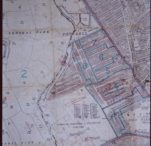
Air raid shelter in Central Park takes a direct hit
There were at least four public air raid shelters built in the park to protect local residents from the Blitz. They were cut into the ground and covered over with concrete slabs and earth. One very large shelter, able to accommodate more than 1,000 people, remains intact on the park’s southern slopes although it is…
-
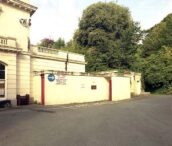
Air Raid Precautions control buildings
The Town Clerk in 1940, Colin Campbell, had the added responsibility of being the Air Raid Precautions (ARP) controller. When bombed out of the municipal offices facing the Guildhall Square in 1941, he and his staff set up a new office in Pounds House and it became the ARP Control Centre, also known as the…