After the initial works and opening in 1931, much of the park consisted of open space partitioned by pathways and hedgebanks. It was a canvas waiting to be filled. The way that the park actually developed is described in other sections but all kinds of ideas have been considered over the years and not taken forward, and they are covered here.
- 1937 Milehouse entrance idea
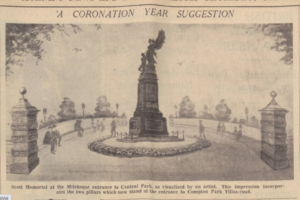 At the start of the Coronation year, 1937, two stone pillars at the entrance to Compton Park Villas Road (now Compton Avenue) became available, prompting a discussion about where they should be re-sited. One suggestion was to make the main entrance to Central Park at Milehouse more imposing. As well as the two pillars,… Read more: 1937 Milehouse entrance idea
- 1963 First ideas for a sports centre
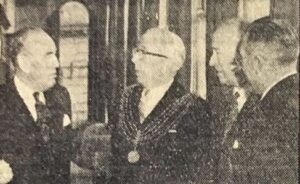 Once a decision had been taken in 1962 to build the new indoor swimming pool in Central Park and not in the city centre as some had wanted, ideas for extending the range of facilities started to emerge. Indoor tennis, indoor bowls, badminton and athletics were all discussed. In 1963, the chairman of Plymouth Argyle… Read more: 1963 First ideas for a sports centre
- 1972 The Pennycomequick flyover
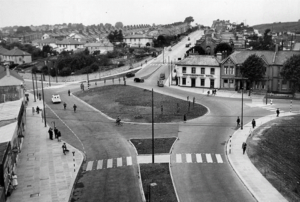 In 1972, Devon County Council – the Highways Authority at the time – made provision for a £10 million dual-carriageway flyover that would have linked the North Cross roundabout with Alma Road and gone directly over the railway and the Pennycomequick roundabout. It would have involved demolishing the Upper and the Lower Knollys Terraces and… Read more: 1972 The Pennycomequick flyover
- 1990 Central Leisure Park
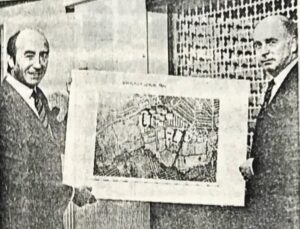 By 1990, the Mayflower Centre and its extensions were starting to look time-worn, having been cheaply constructed. Other sports halls in the city were also at the end of their useful lives. Two businessmen, Keith White and Bob Widdecombe, who had taken over the insolvent Plymouth Sports Club at Peverell Park in 1986, came forward… Read more: 1990 Central Leisure Park
- 1991 Major plans for Central Park
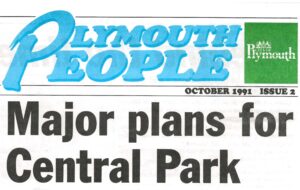 In a four-page edition of ‘Plymouth People’ in 1991, the Council set out its vision for better sports facilities which included refurbishing the run-down Mayflower Centre and the Home Park football stadium. It would have been part-funded by a supermarket on a section of the Outland Road carpark, with a second tier being added to… Read more: 1991 Major plans for Central Park
- 1996 The Tradium
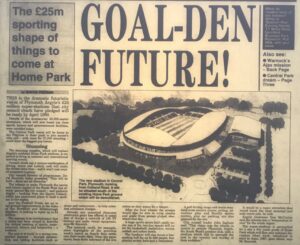 The front page of the Evening Herald on 11th April 1996 unveiled a bold design for a future super-stadium, called the ‘Tradium’, at Home Park. An article inside proclaimed “a unique set of circumstances which have come together at the right time make the city council and Plymouth Argyle certain that the £25 million Central… Read more: 1996 The Tradium
- 2001 Central Park Action Plan
 Extensive consultation in 2000, showed that most people wanted better sports facilities with a new-build replacement for the aging Mayflower Centre but having better park facilities too and not losing green space to development. These aspirations were distilled into the 2001 Central Park Action Plan which highlighted three specific elements: – A new sports centre… Read more: 2001 Central Park Action Plan
- 2008 New housing
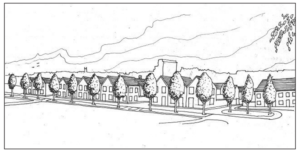 The 2008 Area Action Plan sought to improve the park’s landscape quality and access whilst minimising maintenance commitments and maximising revenue generation. It proposed to create a grand entrance off Alma Road at Pennycomequick, framed between a new lodge building immediately below Knollys Terrace and new terraced housing to the north and east of Wake… Read more: 2008 New housing
- 2009 World Cup host city bid
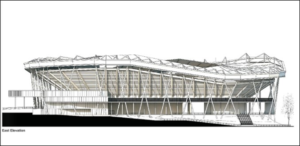 In 2009, English football clubs were vying to be one of the host venues for the 2018 World Cup competition should the country win the bid. Argyle’s prospectus included a redeveloped stadium with a new Mayflower or south stand and a “new ‘Pilgrim Way’ to link the complex to the City Centre via the beautiful… Read more: 2009 World Cup host city bid
- 2013 Plans for Higher Home Park
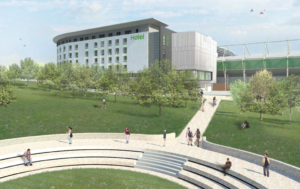 By March 2011, Plymouth Argyle was heavily in debt and its directors decided to put the club into administration. Once the bulk of the debt had been written off, a former banker, James Brent, bought the club and it came out of administration on 31st October 2011. In 2013, one of James Brent’s companies, the… Read more: 2013 Plans for Higher Home Park